

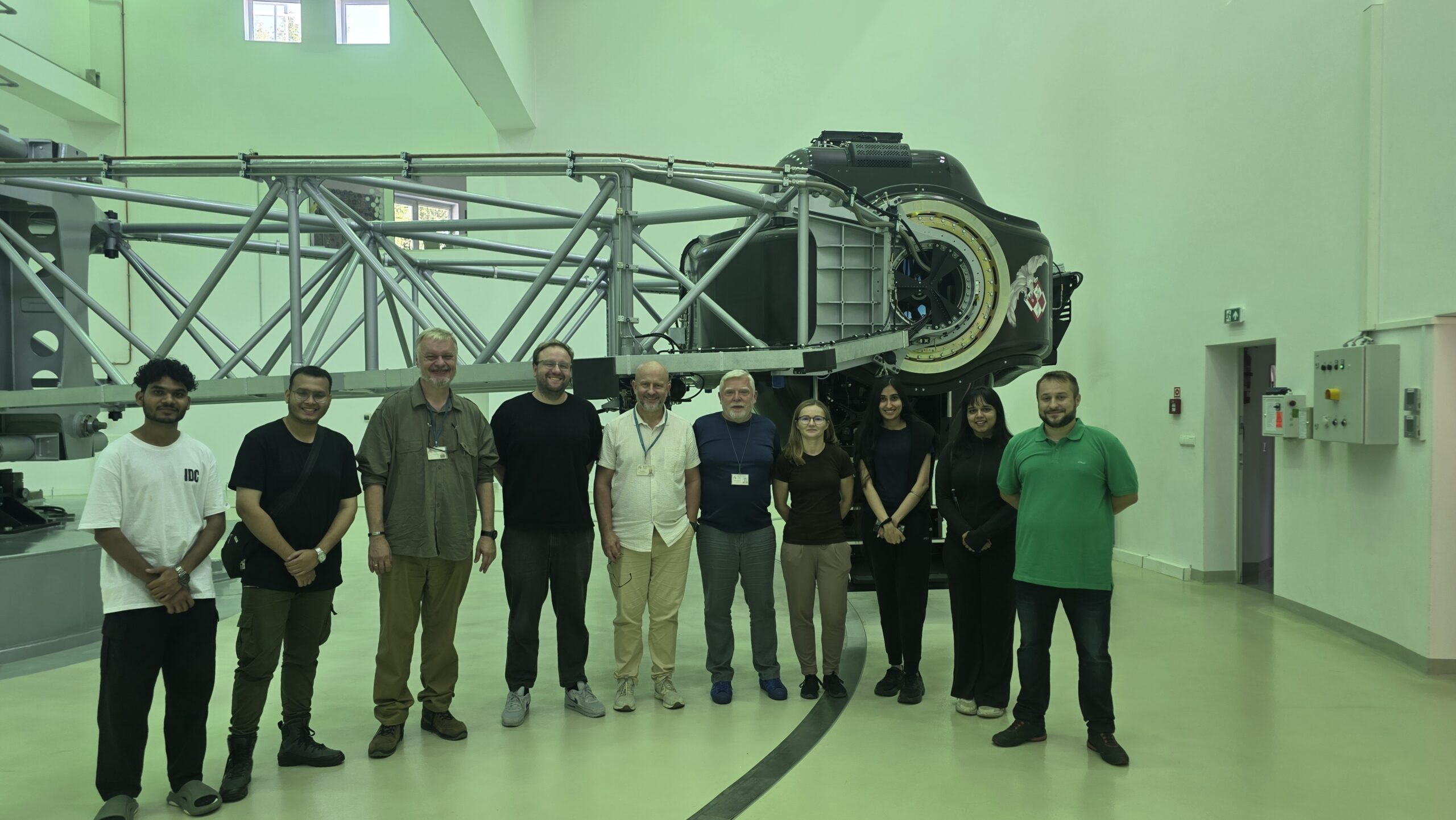
Raipur/Warsaw (Poland)। Chhattisgarh-based space research firm ARKASA – Space Architecture & Design Research Lab has achieved a significant international milestone by successfully completing world-class Human Centrifuge Training in Poland. The military-grade training, undertaken by the firm’s Founder Architect Arshleen Kaur Sahni, Co-Founder Architect Biswajit Das, and the ARKASA team, is the same advanced programme used to prepare fighter pilots flying aircraft such as the F-16, F-35, and MiG-29, as well as astronauts for high-G environments.
Founded in Raipur, ARKASA is an emerging Space Architecture & Design Research Lab working at the intersection of science, architecture, design, and human space exploration. The firm focuses on advancing research and innovation in future lunar and Martian missions, human-centred space habitats, analog astronaut missions, and space education, with the vision of strengthening India’s role in the global space sector.
ARKASA is officially registered under ISRO’s Space Tutor Program and is also part of the IN-SPACe (Indian National Space Promotion and Authorization Centre) startup ecosystem. The firm aims to establish Space Architecture as an emerging discipline in India while inspiring young researchers and students to pursue careers in space science, design, and exploration.
The Human Centrifuge Training was conducted through a collaboration betweenMr. Mateusz Harasymczuk, Founder of Analog Astronaut Training Centre (AATC), Poland, and the Military Institute of Aviation Medicine (WIML), Warsaw. Representing ARKASA were Founder Architect Arshleen Kaur Sahni, Co-Founder Architect Biswajit Das, accompanied by the ARKASA team, including Lumesh Sahu, alongside Anushka Rathore, who also participated in the training.
The Human Centrifuge is among the world’s most advanced astronaut and fighter pilot training systems, exposing participants to extreme G-forces within a controlled environment. During the programme, the team received hands-on training in Anti-G manoeuvres, prevention of G-Induced Loss of Consciousness (G-LOC), human physiological responses to high acceleration, and realistic fighter jet cockpit simulations that replicate the conditions experienced during high-performance military aviation.
Speaking about the achievement, Founder Architect Arshleen Kaur Sahni said that the future of human space exploration depends not only on spacecraft and technology but also on understanding how the human body performs under extreme operational conditions. She added that the knowledge gained through this training will further strengthen ARKASA’s ongoing work in space architecture, human-centred space habitats, and future human spaceflight research.
This achievement marks an important milestone for Chhattisgarh’s emerging space innovation ecosystem. By successfully completing one of the world’s most specialised military-grade aerospace training programmes, ARKASA has demonstrated that Indian researchers and innovators from diverse regions are making meaningful contributions to the future of global human space exploration.